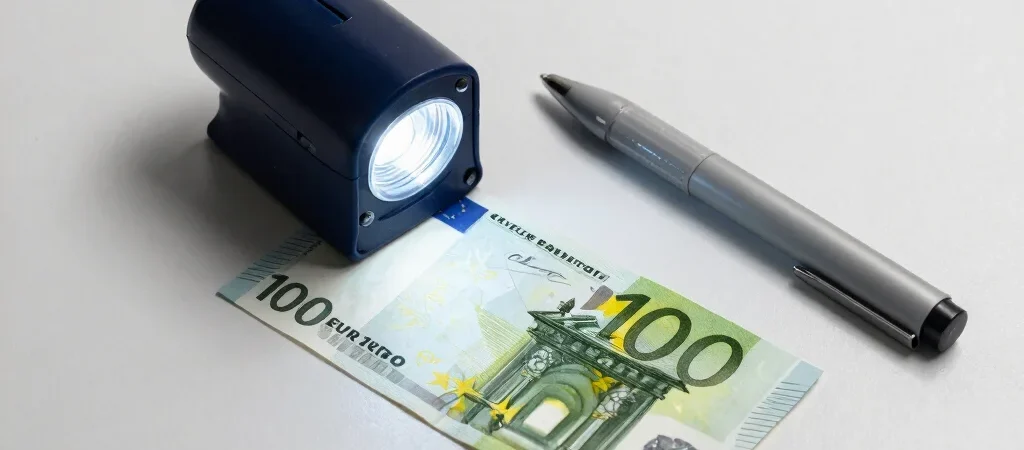
This article is for education only; BuyFakeMoney.eu does not sell counterfeit money. When a euro note seems questionable, a UV lamp or detection pen may offer a clue, but neither is a reliable yes-or-no test on its own.
What a pen actually checks
Most counterfeit-detection pens react to starch often found in ordinary paper. Euro banknotes are made from cotton-fibre paper, but a pen’s mark can still be affected by the surface, treatment, or condition of a note.
That means a pen result should not settle the question: a mark is not conclusive proof that a note is counterfeit, and a clear result does not establish that it is genuine. Avoid making a decision from the pen alone.
What ultraviolet light reveals
Under ultraviolet light, genuine euro banknotes have specific fluorescent features, while the paper itself does not glow uniformly. The details depend on the note’s series, and a suitable lamp and viewing conditions matter.
A UV check can be useful as one part of a broader examination, but a basic lamp may not show every feature clearly. Do not infer authenticity simply because something fluoresces; compare the observed details with official guidance for that denomination and series.
Use a feature sequence instead
For a practical check, start with the feel of the paper and raised print, then hold the note to light for its watermark and security thread. Tilt it to inspect the hologram and color-changing features, and use UV only as an additional check if you have appropriate equipment.
Compare several features with an official European Central Bank reference, making sure the denomination and series match. If the note still seems suspicious, do not pass it on; ask your local police or national central bank what to do next.