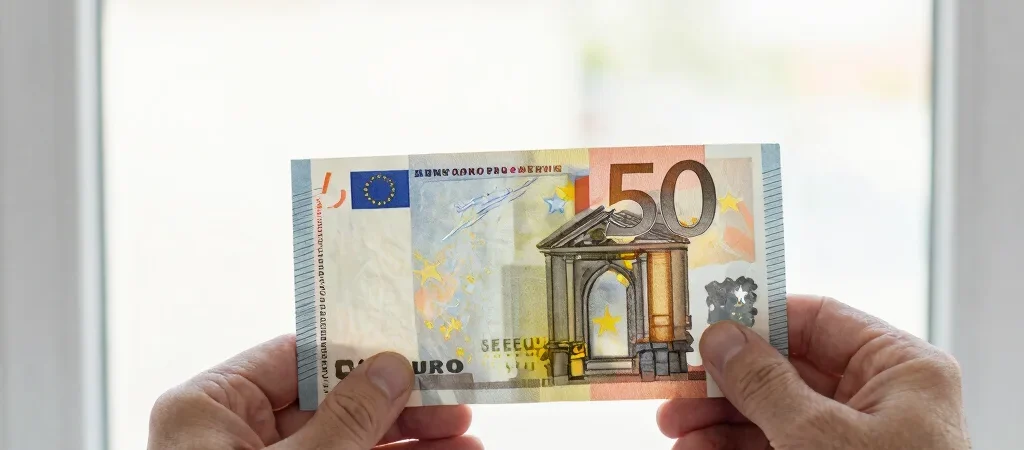
This guide is for education only; BuyFakeMoney.eu does not sell counterfeit money. If you have just received a €50 note, check one feature at a time and compare several features before deciding what to do next.
Start with feel and light
Euro banknotes are printed on cotton-fibre paper, so a genuine note usually feels firm rather than like ordinary office paper. Run a finger over the raised print, especially the large value and the short raised lines near the left and right edges.
Hold the note up to a light source and look for the watermark and the dark security thread inside the paper. On the Europa series €50, the watermark includes a portrait of Europa and the value; the thread shows the € symbol and denomination.
Tilt the note slowly
On an Europa series €50, tilt the note and watch the emerald number on the lower left of the front. Its light effect moves up and down, while the number shifts from emerald green to deep blue.
The hologram on the right changes as you tilt the note. On this series, its transparent window shows a portrait of Europa when held up to the light. Older first-series €50 notes have different security details, so compare like with like using the European Central Bank’s guidance.
Compare before deciding
A single odd-looking detail is not a verdict: wear, lighting, and the banknote series can affect what you see. Compare the note with another €50 of the same series, checking its feel, watermark, thread, and tilt features together.
If several features seem wrong, do not pass the note on. Follow your local police or national central bank’s official instructions for a suspected counterfeit; a note confirmed as counterfeit is generally not reimbursed. This is an educational check, not a guarantee of authenticity.